Better Safe Than Sorry?

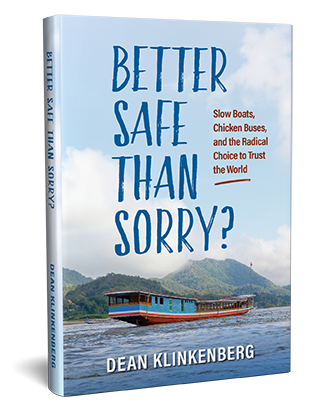
Better Safe Than Sorry? Slow Boats, Chicken Buses, and the Radical Choice to Trust the World
What if the biggest risk in life isn’t taking chances – but letting fear stop you from taking them at all?
At twenty-one, Dean Klinkenberg was accepted into a study-abroad program in Grenoble, France — and backed out. The fear won. He spent one more winter in Wisconsin instead of a semester at the foot of the Alps, and he never forgot which one he’d chosen.
Better Safe Than Sorry? is the story of the years since then when he’s spent choosing differently.
In these essays, Klinkenberg lies awake the night before a flight to Thailand, cataloging everything that could go wrong — then boards an overcrowded slow boat down the Mekong anyway. He rides a chicken bus through Central America, follows a new friend to a family wake in San Salvador, learns salsa in a neighborhood bar, gets lost alone in a Mississippi River marsh, and climbs a sacred mountain in China. He’s scammed, soaked, humbled, and welcomed — over and over — by strangers who turn out to be the best part of every trip. And in the book’s final act, older and slower now, with doubts creeping back into his head, he sets out on six hard weeks traveling through southern Africa to find out whether he still believes what he’s spent a lifetime learning.
What he’s learned is this: the world is not what the news says it is. We’re fed a steady diet of fear — if it bleeds, it leads — until every stranger looks like a threat and staying home feels like wisdom. But a safety-first life has a price. It grows smaller and more isolated. Klinkenberg’s travels didn’t transform him in one lightning-strike epiphany; they shaped him slowly, he writes, like wind moving over a sand dune — into someone who still feels the fear, but no longer lets it drive.
Warm, funny, and disarmingly honest about his own worst decisions, Better Safe Than Sorry? is a memoir about trusting the world and being repaid for it — and an invitation to stop asking “Is it safe?” and start asking what you’re missing.
Better Safe Than Sorry?: Slow Boats, Chicken Buses, and the Radical Choice to Trust the World (eBook)
A memoir about learning that the world is far less dangerous—and far more generous—than we’ve been told.
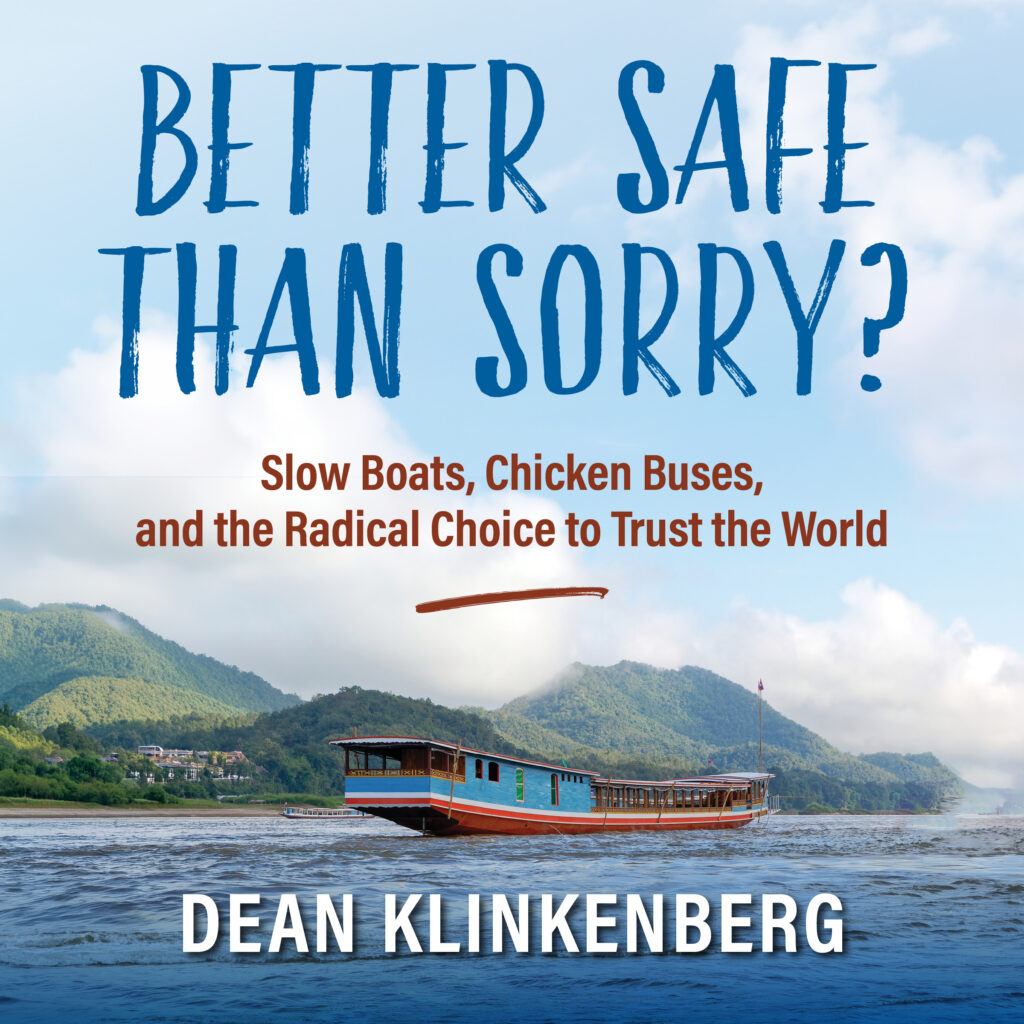
Better Safe Than Sorry?: Slow Boats, Chicken Buses, and the Radical Choice to Trust the World (Audiobook)
A memoir about learning that the world is far less dangerous—and far more generous—than we’ve been told.
Find all editions of the book at other retailers
Photos from Trips Mentioned in the Book


A note about the quotes used in the book
While I was researching this book, I was shocked—utterly shocked!—to learn that the Internet is full of nonsense and lies. This is especially true when it comes to quotes. (Mark Twain and Confucius would be either amused or horrified by many of the quotes attributed to them.) Some of the quotes I had planned on using in this book (even some from such “reputable” sources as Goodreads) turned out to be complete fabrications or, more generously, unintentional misattributions. So, I ditched them (most of them, anyway) and went on a mission to track down the original source of every quote I wanted to use and to attribute them properly. It’s possible I still screwed up one or two, but I’m (mostly) sure that the citations that follow are accurate.
“For what gives value to travel is fear. It breaks down a kind of inner structure we have. One can no longer cheat—hide behind the hours spent at the office or at the plant.”
Albert Camus, “Love of Life” in Lyrical and Critical Essays (New York: Vintage Books, 1970), 54.
“Avoiding danger is no safer in the long run than outright exposure. The fearful are caught as often as the bold.”
Helen Keller, “The Open Door” (1957), American Foundation for the Blind: https://helenkellerarchive.afb.org, series 2, box 228, folder 5, image 6.
“The man who moves a mountain begins by carrying away small stones.”
Paraphrased from Confucius, Analects 9.19 (written between 475 BCE and 220 CE).
“Dr. Charles Steinmetz, the engineering genius, said the other day that there are no foolish questions, and that no man becomes a fool until he has stopped asking questions.”
Frank Crane, “Have You Quit Asking Questions?” The American Magazine 95, no. 5 (May 1923): 41.
“If you’re the kind of person who has no guts, you just give up every time life pushes you. If you’re that kind of person, you’ll live all your life playing it safe, doing the right things, saving yourself for something that never happens. Then, you die a boring old man.”
Robert T. Kiyosaki, Rich Dad Poor Dad: What the Rich Teach Their Kids About Money–That the Poor and Middle Class Do Not! (New York: Warner Books, 2000), 18–19.
“But in any case we ought to move and not to become frozen still by fear: nay, he is the best man who, though peril menaces him on every side and arms and chains beset his path, nevertheless neither impairs nor conceals his virtue: for to keep oneself safe does not mean to bury oneself.”
Lucius Annaeus Seneca the Younger, “Of Peace of Mind” (ca. 49–62 CE) in Minor Dialogues Together with the Dialogue On Clemency, translated by Aubrey Stewart (London: George Bell and Sons, 1889), 264, https://www.gutenberg.org/files/64576/64576-h/64576-h.htm.
“Letting go gives us freedom, and freedom is the only condition for happiness.”
Thích Nhất Hạnh, The Heart of the Buddha’s Teaching: Transforming Suffering into Peace, Joy, and Liberation (New York: Harmony, 1999), 78.
“Most things will be okay eventually, but not everything will be. Sometimes you’ll put up a good fight and lose. Sometimes you’ll hold on really hard and realize there is no choice but to let go.”
Cheryl Strayed, from Dear Sugar, The Rumpus Advice Column #64: Tiny Beautiful Things (February 10, 2011), https://therumpus.net/2011/02/10/dear-sugar-the-rumpus-advice-column-64/.
“Letting go gives us freedom, and freedom is the only condition for happiness. If, in our heart, we still cling to anything—anger, anxiety, or possessions—we cannot be free.”
Thích Nhất Hạnh, The Heart of the Buddha’s Teaching: Transforming Suffering into Peace, Joy, and Liberation (New York: Harmony, 1999), 139–40.
“There is no growth in the comfort zone.”
Jocko Willink and Leif Babin, The Dichotomy of Leadership: Balancing the Challenges of Extreme Ownership to Lead and Win (New York: St. Martin’s Press, 2018), 113.
“One’s destination is never a place, but rather a new way of looking at things.”
Henry Miller, Big Sur and the Oranges of Hieronymus Bosch (New York: New Directions, 1957), 25.
“A tree as wide as a man’s embrace
Grows from a tiny shoot.
A tower of nine stories
Starts with a pile of dirt.
A climb of eight hundred feet
Starts where the foot stands.”
Laozi, Tao Te Ching, chapter 64 (composed between 475 and 221 BCE), https://www.taoistic.com/taoteching-laotzu/taoteching-64.htm.
“The only true voyage of discovery, the only fountain of Eternal Youth, would be not to visit strange lands but to possess other eyes, to behold the universe through the eyes of another, of a hundred others, to behold the hundred universes that each of them beholds, that each of them is.”
Marcel Proust, The Captive, vol. 5 of In Search of Lost Time, translated by Carol Clark, edited by Christopher Prendergast (New York: Penguin Books, 2003 [originally published 1923]), 142.
“Not I, not any one else can travel that road for you,
You must travel it for yourself. It is not far, it is within reach,
Perhaps you have been on it since you were born and did not know,
Perhaps it is everywhere on water and on land.”
Walt Whitman, “Song of Myself,” section 46 (1855), in Leaves of Grass (Philadelphia: David McKay, 1891–92), 29–79, Walt Whitman Archive.
“The man who asks a question is a fool for a minute, the man who does not ask is a fool for life.”
Often attributed to Confucius, but probably a generous interpretation and reinterpretation of his comments in Analects 15.30 and 2.17.
“Few things are as exciting as the idea of travelling somewhere else. But the reality of travel seldom matches our daydreams.”
Sales description for Alain de Botton,The Art of Travel (New York: Vintage International, 2004), https://www.alaindebotton.com/travel/.
“Twenty years from now you will be more disappointed by the things that you didn’t do than by the ones you did do. So throw off the bowlines. Sail away from the safe harbor. Catch the trade winds in your sails. Explore. Dream. Discover.”
Sarah Frances Brown, as quoted by her son, author H. Jackson Brown Jr., in P.S. I Love You (Nashville, TN: Rutledge Hill Press, 1990), 13—but often misattributed to Mark Twain.
“For there we loved, and where we love is home, Home that our feet may leave, but not our hearts.”
Oliver Wendell Holmes, “Homesick in Heaven,” Poetical Works of Oliver Wendell Holmes (Boston and New York: Houghton, Mifflin, 1908), 185.
“Traveling is a brutality. It forces you to trust strangers and to lose sight of all that familiar comfort of home and friends. You are constantly off balance.”
Many online forums attribute this quote to Cesare Pavese from his book This Business of Living: Diaries 1935–1950. But I read a 2009 edition of it (New Brunswick, NJ: Transaction Publishers) and did not find this quote. It’s possible the quote appears in an earlier edition of that book that I didn’t have access to, but I absolutely love the sentiment, so I included the quote anyway.
“Hospitality means primarily the creation of free space where the stranger can enter and become a friend instead of an enemy.”
Henri Nouwen, Reaching Out: The Three Movements of the Spiritual Life (New York: Doubleday, 1985), 55.
“I was a stranger and you welcomed me.”
Matthew 25:35 (Revised Standard Version).
“A ship in harbor is safe, but that is not what ships are built for.”
John A. Shedd, Salt from My Attic (Portland, ME: Mosher Press, 1928), 20—but often misattributed to Grace Hopper.
“What you discover on your own is always more exciting than what someone else discovers for you—it’s like the difference between romantic love and an arranged marriage.”
This quote is attributed to the movie critic Terrence Rafferty on various websites, but I have not been able to locate the original source. It’s possible that it’s completely made up or that it originated with someone else, but because I love the sentiment, I includes it anyway.
“We do not free ourselves from something by avoiding it, but only by living through it.”
Cesare Pavese,This Business of Living, Diaries 1935–1950 (New Brunswick, NJ: Transaction Publishers, 2009), 265 (diary entry of November 22, 1945).